ISO 216 · A-series
A0 paper size — 841 × 1189 mm
A0 is 841 × 1189 millimetres (33.11 × 46.81 in) and is derived from an area of one square metre (999,949 mm² once rounded to whole millimetres) — it is the mathematical anchor from which every other A-series size is derived by halving. A0 is the standard for academic conference posters, architectural plans and exhibition graphics.
Next: Check a photo is sharp enough for A0·Print it at exactly A0·Convert to pixels, points or inches
A0 — instant conversion
| Unit | Width | Height |
|---|---|---|
| Millimetres (mm) | 841 mm | 1189 mm |
| Centimetres (cm) | 84.1 cm | 118.9 cm |
| Inches (in) | 33.11 in | 46.811 in |
| Pixels @ 300 DPI | 9933 px | 14043 px |
| PostScript points (pt) | 2383.9 pt | 3370.4 pt |
| Picas | 198.66 | 280.87 |
Change the DPI selector to see the pixel resolution at 72, 96, 150, 200, 300 or 600 DPI. Physical dimensions (mm, cm, in, pt, picas) do not change with DPI.
A0 resolution for large-format print
At poster scale, DPI requirements drop with viewing distance. A0 is almost never examined from 30 cm the way a business card is — most A0 posters are read from 1.5 m or more, which is why the industry standard for A0 production is 150 DPI, not 300.
| DPI | Pixels | Megapixels | Good for |
|---|---|---|---|
| 72 | 2384 × 3370 | 8 MP | Viewing beyond 5 m |
| 100 | 3311 × 4681 | 15.5 MP | Wall posters, 3 m+ |
| 150 | 4967 × 7022 | 34.9 MP | Production standard for A0 |
| 300 | 9933 × 14043 | 139 MP | Close-inspection art prints only |
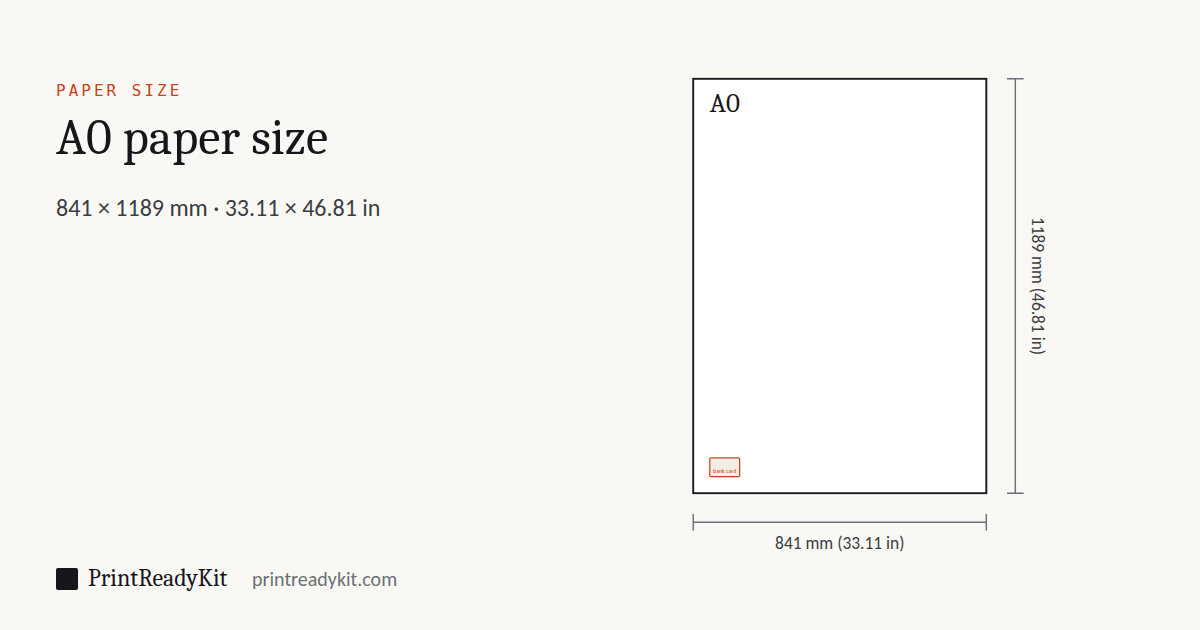
A0 · 841 × 1189 mm
Dashed outline: a standard credit card (ISO/IEC 7810, 85.6 × 54 mm) at the same scale.
The A-series ladder from A0
Where A0 is used
- Academic and scientific conference posters
- Architectural plans and construction drawings
- Trade-show and exhibition graphics
- Event, cinema and concert posters
- Classroom and training wall charts
- Retail window displays
Printing A0 without a plotter
By area an A0 sheet is exactly 16 × A4, but a home print takes more: the printer leaves a margin and every join needs an overlap to trim, so at a 5 mm margin and a 10 mm overlap the design splits into 3 × 7 = 21 A4 pages. Print them, trim one overlapping edge of each and assemble with tape from the back. Our poster splitter works out the grid, overlap and trim lines for any target size.
For a professional finish, online large-format services print true A0 on 150–200 gsm satin or blueback paper at low cost — usually the better route for anything client-facing.
What are you trying to do?
Most people looking up A0 are partway through something else. These open with the size already set.
- Check a photo is sharp enough for A0Drop in the image and see its effective resolution at this size.
- Print it at exactly A0Where the 100% setting hides, and why Fit to page changes the scale at all.
- Convert to pixels, points or inchesEvery unit at any DPI, plus photocopier scaling percentages.
- Print A0 across ordinary sheetsTile it onto A4 or Letter with overlap and alignment marks.
Frequently asked questions
How big is A0 paper?
A0 is 841 × 1189 mm — 84.1 × 118.9 cm, 33.11 × 46.81 in. To picture it: the full square metre the A-series starts from, and the size of a standard architectural plan or a large exhibition poster. If you need it in pixels the answer depends on resolution — the table above gives every common DPI.
What are the dimensions of A0?
A0 is 841 × 1189 millimetres — 84.1 × 118.9 cm, approximately 33.11 × 46.81 inches. It is derived from an area of one square metre (999,949 mm² at the standardised whole-millimetre dimensions), the anchor property of the ISO 216 A-series.
Why is A0 based on one square metre?
ISO 216 anchors the A-series on two rules: A0 has an area of 1 m², and every sheet has a 1:√2 aspect ratio. Those two constraints produce 841 × 1189 mm (841 × 1189 = 999,949 mm² ≈ 1 m² after rounding to whole millimetres). Every smaller size follows by halving.
How many A4 sheets fit in an A0?
Nominally sixteen (A0 = 2 × A1 = 4 × A2 = 8 × A3 = 16 × A4 in the halving series). Tiled edge to edge, sixteen A4 pages cover 840 × 1188 mm of A0's 841 × 1189 mm — a 1 mm rounding remainder per axis, which is one reason poster tiling always uses overlaps rather than exact butting. Printed at home it takes more: a printer cannot print to the edge and each join needs an overlap to trim, so with a 5 mm margin and a 10 mm overlap the grid is 3 × 7 = 21 A4 sheets.
What is A0 in pixels at 300 DPI?
At 300 DPI, A0 is 9933 × 14043 pixels — about 139 megapixels. In practice, A0 posters are viewed from a distance, so 150 DPI (4967 × 7022 px, ~35 MP) is the common production target and 100 DPI is acceptable for viewing beyond 3 m.
Can I print A0 at home?
Not directly — A0 needs a large-format plotter. Two realistic options: order from an online large-format print service (usually the cheapest per print), or tile the poster across A4 sheets — 21 at a 5 mm printer margin and a 10 mm overlap — with the poster splitter, and assemble with tape or glue.
What is A0 used for?
Academic conference posters, architectural and engineering plans, trade-show and exhibition graphics, movie and event posters, and technical wall charts.
What resolution should an A0 conference poster be?
Design at the full 841 × 1189 mm size in a vector tool if possible. For raster elements, 150 DPI at final size is the realistic standard (4967 × 7022 px); 300 DPI files become unwieldy (139 MP) with no visible benefit at typical viewing distance.
What is the difference between A0 and 2A0?
2A0 (sometimes A00) is a double-A0 sheet at 1189 × 1682 mm, defined in DIN 476 but not part of ISO 216 proper. It appears mainly in large-format plotting for engineering.