ISO 216 · A-series
A1 paper size — 594 × 841 mm
A1 is 594 × 841 millimetres (23.39 × 33.11 in) — the half-step below A0 and the most common size for indoor posters, flip charts and architectural drawings. Large enough to command a wall, small enough to carry rolled.
Next: Check a photo is sharp enough for A1·Print it at exactly A1·Convert to pixels, points or inches
A1 — instant conversion
| Unit | Width | Height |
|---|---|---|
| Millimetres (mm) | 594 mm | 841 mm |
| Centimetres (cm) | 59.4 cm | 84.1 cm |
| Inches (in) | 23.386 in | 33.11 in |
| Pixels @ 300 DPI | 7016 px | 9933 px |
| PostScript points (pt) | 1683.8 pt | 2383.9 pt |
| Picas | 140.31 | 198.66 |
Change the DPI selector to see the pixel resolution at 72, 96, 150, 200, 300 or 600 DPI. Physical dimensions (mm, cm, in, pt, picas) do not change with DPI.
A1 pixel sizes at every DPI
A1 is defined in millimetres, so its pixel dimensions depend entirely on the resolution you choose — and at poster sizes that choice matters more than usual, because the file grows with the square of the DPI. A1 at 300 DPI is a 70-megapixel image; at 150 DPI it is 17 megapixels and, viewed from the distance a poster is actually seen, indistinguishable.
| Resolution | Pixels | Megapixels | Use |
|---|---|---|---|
| 72 DPI | 1684 × 2384 | 4 MP | Screen preview only |
| 96 DPI | 2245 × 3179 | 7.1 MP | CSS reference resolution |
| 150 DPI | 3508 × 4967 | 17.4 MP | Posters seen from a metre or more — the usual choice for A1 |
| 300 DPI | 7016 × 9933 | 69.7 MP | Commercial print, or anything examined close up |
| 600 DPI | 14031 × 19866 | 278.7 MP | Line art and fine type; rarely needed for photographs |
In points, A1 is 1684 × 2384 pt — the figure a PDF page box reports. Not sure whether your image holds up at this size? Check its resolution against A1 before committing to a print.
A1 in the A-series
| Size | Millimetres | Relation to A1 | Page |
|---|---|---|---|
| A0 | 841 × 1189 | 2 × A1 | A0 page |
| A1 | 594 × 841 | — | (this page) |
| A2 | 420 × 594 | ½ × A1 | A2 page |
| A3 | 297 × 420 | ¼ × A1 | A3 page |
| A4 | 210 × 297 | ⅛ × A1 | A4 page |
Resolution guide: at 150 DPI (the large-format standard) A1 is 3508 × 4967 px (17.4 MP). A 300 DPI file reaches 70 MP with no visible benefit at normal poster viewing distance.
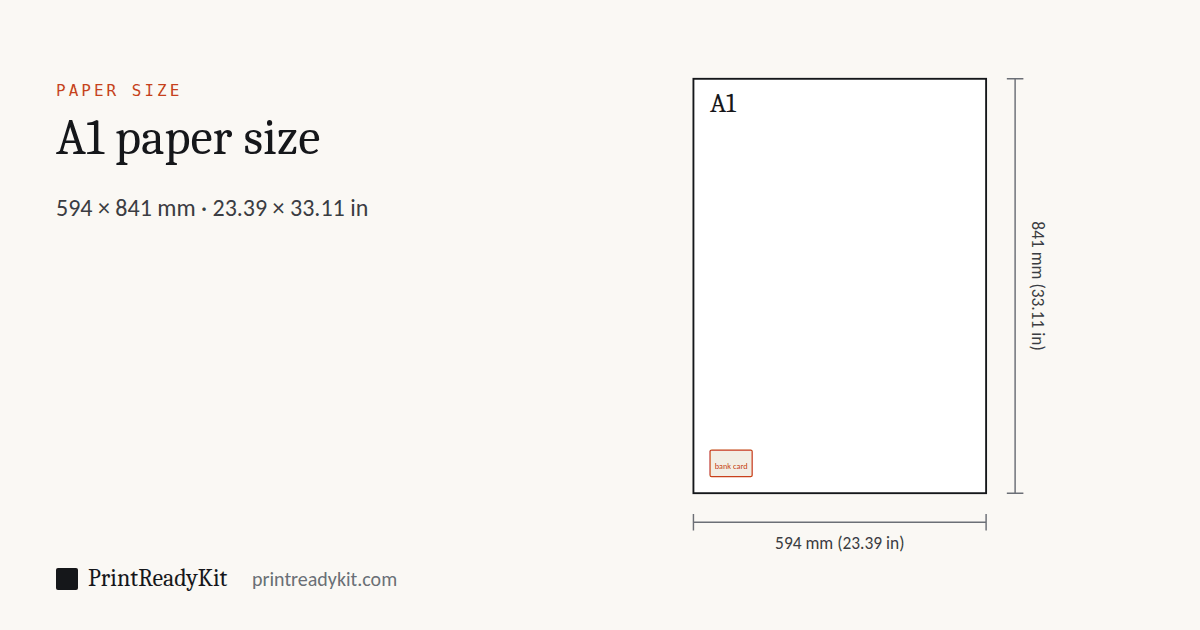
A1 · 594 × 841 mm
Dashed outline: a standard credit card (ISO/IEC 7810, 85.6 × 54 mm) at the same scale.
Where A1 is used
- Indoor advertising and event posters
- Flip charts and presentation pads
- Architectural and engineering drawings
- Exhibition and conference panels
- Shop-window and point-of-sale displays
- Classroom charts and teaching aids
A1 poster design specs
- Bleed
- 3–5 mm → export up to 604 × 851 mm
- Headline size
- 72 pt+ for reading at 2–3 m
- Body text
- 24 pt+ so it remains readable at 1 m
- Home printing
- Tile across 12 A4 sheets (4 × 3, with a 5 mm margin and 10 mm overlap) — use the poster splitter
What are you trying to do?
Most people looking up A1 are partway through something else. These open with the size already set.
- Check a photo is sharp enough for A1Drop in the image and see its effective resolution at this size.
- Print it at exactly A1Where the 100% setting hides, and why Fit to page changes the scale at all.
- Convert to pixels, points or inchesEvery unit at any DPI, plus photocopier scaling percentages.
- Print A1 across ordinary sheetsTile it onto A4 or Letter with overlap and alignment marks.
A1 vs the sizes it gets confused with
A1 is the international large-poster size, but a design brief may specify one of two American formats that are close enough to look interchangeable and are not.
| Size | Millimetres | Inches | Against A1 |
|---|---|---|---|
| A1 | 594 × 841 | 23.39 × 33.11 | — |
| ARCH D | 610 × 914 | 24 × 36 | 16 mm wider, 73 mm taller — the US architectural equivalent |
| 24 × 36 in poster | 610 × 914 | 24 × 36 | Same sheet as ARCH D; the standard US poster and frame size |
| A0 | 841 × 1189 | 33.11 × 46.81 | Twice the area — A1 is A0 folded once |
The practical consequence: an A1 design sent to a US printer expecting 24 × 36 inches arrives 3% short in width and 8% short in height, leaving an uneven white border. The aspect ratios differ too — 1:1.414 against 1:1.5 — so no single scaling percentage fixes it. Decide the target size before designing, or keep anything critical well inside a shared safe area.
Frequently asked questions
How big is A1 paper?
A1 is 594 × 841 mm — 59.4 × 84.1 cm, 23.39 × 33.11 in. To picture it: roughly the size of a flip-chart pad or an indoor cinema poster, and half an A0. If you need it in pixels the answer depends on resolution — the table above gives every common DPI.
What size is A1 paper?
A1 is 594 × 841 millimetres — 59.4 × 84.1 cm, approximately 23.39 × 33.11 inches. It sits between A0 and A2 in the halving series — nominally half of A0 and double A2 (ISO rounds every size to whole millimetres, so both ratios land within 0.15 % of exact).
What is A1 in pixels?
At 150 DPI (the practical large-format standard) A1 is 3508 × 4967 pixels. At 300 DPI it is 7016 × 9933 px (~70 MP) — rarely needed since A1 is viewed from a distance.
What is A1 used for?
Indoor posters, flip charts, architectural drawings, exhibition panels, shop-window displays and classroom charts. A1 is the largest size that is still easy to carry rolled under one arm.
How many A4 sheets make an A1?
Nominally eight (A1 = 2 × A2 = 4 × A3 = 8 × A4 in the halving series), and eight A4 sheets butted edge to edge would fall a millimetre short, because ISO rounds sizes to whole millimetres. Printed at home it takes more: a printer cannot print to the edge and each join needs an overlap to trim, so with a 5 mm margin and a 10 mm overlap the grid is 4 × 3 = 12 A4 sheets.
Is A1 a standard flip-chart size?
Yes — most flip-chart pads are A1 (594 × 841 mm), occasionally slightly trimmed to fit specific easel clamps. When buying replacement pads, check the easel's clamp width against the 594 mm sheet width.
What is A1 in pixels at 300 DPI?
7016 × 9933 pixels, which is a 70-megapixel image and typically a very large file. For a poster that is the wrong target: A1 is normally viewed from a metre or more away, where roughly 150 DPI — 3508 × 4967 pixels, or 17 megapixels — is already beyond what the eye resolves at that distance. Reserve 300 DPI for A1 work that will be examined close up, such as technical drawings or a poster with small type.
Is A1 the same as a 24 × 36 inch poster?
No. A 24 × 36 inch poster is 610 × 914 mm, while A1 is 594 × 841 mm — 16 mm narrower and 73 mm shorter, with a different aspect ratio (1:1.414 against 1:1.5). They are the standard large-poster size in their own markets and are not interchangeable: an A1 file printed at 24 × 36 leaves an uneven border, and there is no single percentage that converts one to the other cleanly.
Can a home printer print A1?
No — A1 requires a large-format plotter (common in architecture offices and copy shops). At home, either tile across 12 A4 sheets (at a 5 mm margin and a 10 mm overlap) or order from an online large-format print service.