Tool
Box template and net generator
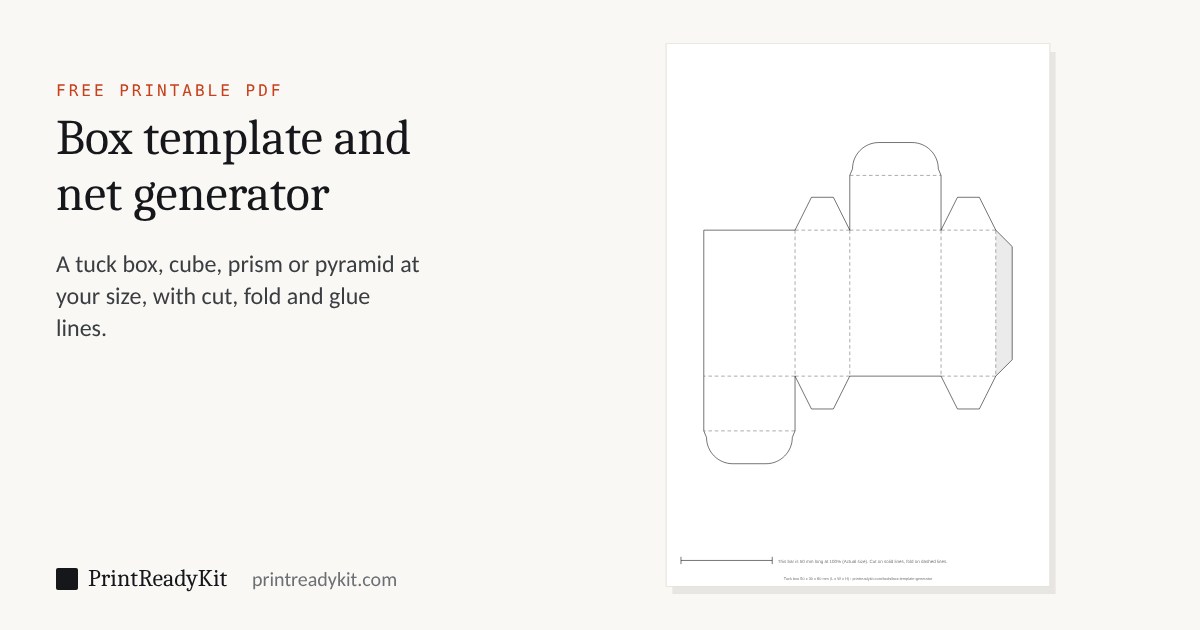
A printable box or net at the size you type: a tuck-flap box, a cube or rectangular prism (as a dice if you like), a triangular prism or a square pyramid. Solid lines to cut, dashed lines to fold, and glue tabs where the edges meet — on A4 or US Letter, or a bigger sheet when the box needs it.
The net is 169 mm × 176 mm and prints on A4.
- Print the PDF at Actual size or 100%, on card of 160–300 gsm.
- Score the dashed lines, cut the solid ones, then fold.
- Glue the grey tabs inside, one face at a time; hold each for a few seconds.
How to make the box
- Print on card at 100% and check the bar at the foot of the page: 50 mm, or 2 in.
- Score every dashed line along a ruler with an empty pen or a bone folder.
- Cut round the solid outline. Scissors are fine; a craft knife on a mat gives cleaner corners.
- Fold every scored line the same way, with the printed side in, so the lines end up inside the box.
- Glue the side tab first to make the tube of walls, then the tabs at each end. A tuck box needs only the side flap: its ends close with the flaps.
Which shape to choose
The tuck box opens and closes again — for gifts, cards or small parts. A cube net or rectangular prism net is glued shut, as in a maths lesson on surface area (lay the net flat and add up its rectangles) or for a dice template and paper toys. A triangular prism net makes a tent card or a chocolate-bar box, and the square pyramid a classroom model or a small gift.
For flat shapes to cut out — hearts, stars and circles — use printable shapes; to measure angles on a model, the printable protractor.
Keeps these settings in the link. Useful for moving from a phone to the computer with the printer on it.
Share with a class
Posts a link to this tool with these settings. Nothing loads from Google or Microsoft until you press a button.
Frequently asked questions
Are the sizes inside or outside the box?
They are the sizes of the folded box, measured on the fold lines — so on thin paper the inside is the size you typed. Card takes up a little room at every fold: with 250–300 gsm card, add about 1 mm to each size for something that has to fit inside, such as a gift or a deck of cards.
What paper is best for a box?
Card stock of 160–300 gsm (60–110 lb cover). Lighter paper folds easily but makes a floppy box; heavier card needs scoring first. Most home inkjet and laser printers take up to about 200–250 gsm through the rear or manual feed.
How do I get sharp folds?
Score every dashed line before folding: run an empty ballpoint pen, the back of a butter knife or a bone folder along a ruler on each fold line. The card then bends exactly on the line, and the box comes out square.
What is a net, and how many nets does a cube have?
A net is the flat shape that folds up into a solid. A cube has 11 different nets; the one here is the cross, the easiest to fold and glue. A rectangular prism unfolds the same way with rectangles in place of squares, a triangular prism into three rectangles and two triangles, and a square pyramid into a square with four triangles around it.
What if my box does not fit on the page?
The tool moves up to the next sheet that holds it — A3 from A4, Tabloid (11 × 17 in) from Letter — and says so. If even that is too small, it makes a page as large as the box needs, for a print shop or a plotter. A box roughly up to 50 × 30 × 80 mm (2 × 1¼ × 3 in) fits on A4 or Letter as a tuck box.
Last updated