Tool
Lined and graph paper generator
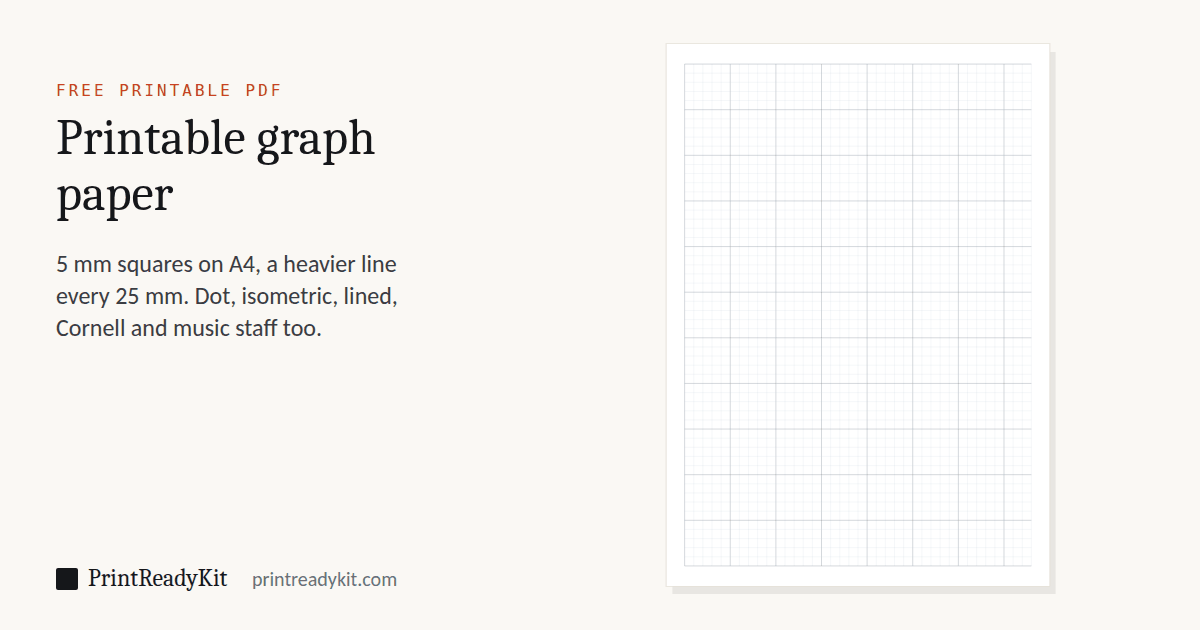
Print lined paper — college ruled, wide ruled or metric, with or without a margin line — or square-grid, dot-grid and isometric sheets at any spacing in millimetres or inches, including engineering paper, a coordinate plane with numbered axes, hexagonal, polar and logarithmic (semi-log and log-log) graph paper, Cornell notes, handwriting paper with a dashed midline, calligraphy guide sheets with slant lines, and music staff paper. Download as a PDF (recommended — fixed page size, 10 mm print-safe border, prints accurately at 100%) or as an SVG.
Settings
Keeps these settings in the link. Useful for moving from a phone to the computer with the printer on it.
Share with a class
Posts a link to this tool with these settings. Nothing loads from Google or Microsoft until you press a button.
Frequently asked questions
How accurate is the grid when printed?
The SVG is generated in millimetres at 1:1 scale. The accuracy of the final print depends on your printer and on whether your browser or PDF reader prints at 100% (Actual size) instead of "Fit to page". Always disable scaling for measurement-accurate grids.
Can I use this for engineering, dot grid or isometric drawings?
Yes — switch the style above. For engineering work, choose a metric spacing such as 5 mm or 10 mm with subdivisions to match drafting conventions. Isometric mode draws the standard triangular lattice (vertical lines plus two families at 30° from horizontal) used for 3D sketching, where the spacing value sets the triangle side.
How do I print engineering paper?
Choose Square grid and the Engineering preset: 5 squares to the inch with a heavier line every inch, the grid of engineering computation paper. Quad ruled (4 to the inch) and a metric 1 mm grid with a 1 cm major line are presets too.
Can I make a coordinate plane with numbered axes?
Yes. With Square grid or Dot grid, set Axes to Centre for four quadrants or Corner for the first quadrant only. The axes are drawn on grid lines and numbered in squares from the origin — on every line when the squares are at least 4.5 mm, otherwise on the major lines — so a 5 mm or ¼ in grid gives the classroom coordinate plane.
How is the Cornell notes page laid out?
As Cornell University’s Learning Strategies Center describes the system: a 2½ in cue column on the left, the note-taking column beside it, and a 2 in summary area at the foot of the page. The lines use any ruling from the Lined style — college ruled by default. On pages narrower than Letter the cue column is kept to about a third of the width.
Do you have handwriting paper with a dashed middle line?
Choose Handwriting: each row has a solid top line, a dashed midline and a solid baseline, with a half-row gap between rows. Presets give 1 in, ⅝ in and ½ in from top line to baseline, the usual sizes from the first years of school onwards, or 15 mm.
How big are the staves on the music paper?
The spacing is the distance between two staff lines, so a staff is four times that: 2 mm gives an 8 mm staff, a comfortable size for writing by hand. Choose how many staves you want; if they would not fit, the page takes as many as it can and says so.
How do I print college ruled or wide ruled paper?
Choose Lined as the style, then College ruled (9/32 in, 7.14 mm between lines), Wide ruled (11/32 in, 8.73 mm) or Narrow ruled (1/4 in, 6.35 mm) — the three US school rulings — or 8, 7 or 6 mm for European exercise-book paper. The first line sits 22 mm from the top, leaving room for a name and date, and the red margin line is 1¼ in from the left edge as on US filler paper; untick it for plain lines. Print the PDF at Actual size, or the spacing shrinks with the page.
Can I print hexagonal (hex) paper?
Choose Hexagonal, then pointy-top or flat-top hexagons, and give the size either as the side length or as the width across the flats; the two are related by flat-to-flat = side × √3 (1.732), so a 10 mm side is 17.32 mm across the flats. Only whole hexagons are drawn, centred on the page, and the note under the settings gives both measurements.
How is the logarithmic paper ruled?
Each cycle (decade) covers a factor of ten. Inside a decade the line for a value k sits log10(k) of the way up, so 2 is 30.1 % of the decade, 3 is 47.7 % and 5 is 69.9 %, with heavier lines at each power of ten. Semi-log paper has 1 to 5 cycles up the page and a linear axis across it at the spacing you choose; log-log paper has 1 to 5 cycles on both axes.
Do you have calligraphy guide sheets with slant lines?
Choose Calligraphy and set the nib width; the x-height, ascender and descender are counted in nib widths, as calligraphers measure them — italic is commonly written at an x-height of 5 nib widths and foundational hand at 4. A ladder of nib-wide squares starts each row. Slant lines can be added at 52° (Spencerian), 55° (Copperplate), 60°, 83° (italic, about 7° off vertical) or any angle from 30° to 90°. For a pointed pen, which has no edge width, treat the nib width as a unit: 1 mm with 3, 2 and 3 gives the 3:2:3 Copperplate proportions.
What are the polar grid and the subdivisions?
The polar grid draws rings at the spacing you set around the centre of the page and spokes every 5°, 10°, 15°, 30° or 45°, numbered in degrees round the rim, for plotting angles and directions. On the square grids, subdivisions are the fine lines inside each major square: a 10 mm major grid with 5 subdivisions adds a 2 mm fine grid, drawn lighter so the eye can tell the two apart.
Last updated
Related
- Graph paper guideSpacings, naming and paper weights
- Dot grid paperThe bullet-journal layout, explained
- Isometric paperThe 30° grid for 3D sketching
- Printable rulerVerify your printer’s 100 % scale
- Print at actual sizeKeep the grid ruler-true
- Label sheet generatorAnother precision template tool
- Number line generatorNumber lines for worksheets and walls