US traditional size
Legal paper size — 8.5 × 14 inches
US Legal is 8.5 × 14 inches — exactly 215.9 × 355.6 mm and 2550 × 4200 pixels at 300 DPI. Same width as Letter, three inches taller. Despite the name, most US courts now require Letter; Legal lives on in deeds, leases, notarial work and long landscape spreadsheets.
Next: Check a photo is sharp enough for US Legal·Print it at exactly US Legal·Convert to pixels, points or inches
Legal — instant conversion
| Unit | Width | Height |
|---|---|---|
| Millimetres (mm) | 215.9 mm | 355.6 mm |
| Centimetres (cm) | 21.59 cm | 35.56 cm |
| Inches (in) | 8.5 in | 14 in |
| Pixels @ 300 DPI | 2550 px | 4200 px |
| PostScript points (pt) | 612 pt | 1008 pt |
| Picas | 51 | 84 |
Change the DPI selector to see the pixel resolution at 72, 96, 150, 200, 300 or 600 DPI. Physical dimensions (mm, cm, in, pt, picas) do not change with DPI.
Legal in pixels — exact at every DPI
Inch-defined sizes convert to whole pixels at every standard resolution — the same convenience Letter enjoys, three inches taller.
| DPI | Width (px) | Height (px) | Typical use |
|---|---|---|---|
| 72 | 612 | 1008 | Legacy screens — also the PDF point size |
| 96 | 816 | 1344 | Windows / web display |
| 150 | 1275 | 2100 | Draft print, everyday scans |
| 300 | 2550 | 4200 | Commercial print standard |
| 600 | 5100 | 8400 | Fine text, archival scans |
Other values: 21.59 × 35.56 cm, 612 × 1008 pt, area 119 in² (767.7 cm²), aspect ratio 1 : 1.647 — noticeably slimmer than both Letter (1 : 1.294) and A4 (1 : 1.414).
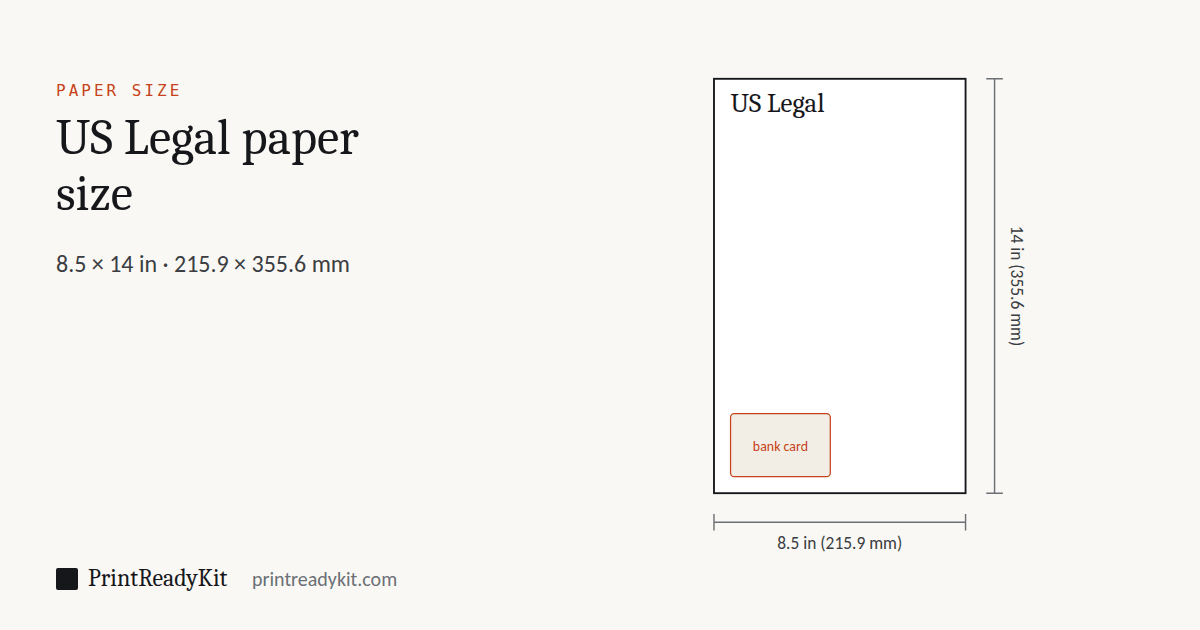
Legal · 8.5 × 14 in
Dashed outline: a standard credit card (ISO/IEC 7810, 85.6 × 54 mm) at the same scale.
Legal vs Letter, A4 and Foolscap
| Size | Inches | Millimetres | Notes |
|---|---|---|---|
| US Legal | 8.5 × 14 | 215.9 × 355.6 | (this page) |
| US Letter | 8.5 × 11 | 215.9 × 279.4 | same width, 3 in shorter |
| A4 | 8.27 × 11.69 | 210 × 297 | the rest-of-world standard |
| Long bond (Foolscap folio) | 8.5 × 13 | ≈ 216 × 330 | long bond in the Philippines; the old British Foolscap folio |
| Tabloid (ANSI B) | 11 × 17 | 279.4 × 431.8 | the next US step up |
Where Legal is still used
- Real-estate deeds, leases and closing packets
- Notarial and title documents
- Long contracts where fewer signature pages matter
- Wide landscape spreadsheets and financial statements
- Restaurant menus that want a tall, slim format
- Government archives holding pre-Letter-era filings
Working with Legal in practice
- Print on Letter instead
- "Fit" scales to 79 % (11 ÷ 14) — small type suffers
- Envelope folding
- fold in 4 (3.5 in panels) for a #10 · tri-fold needs a #14
- Scanning
- flatbeds are Letter/A4 — Legal needs the document feeder (set size!)
- Filing
- use legal-size folders/cabinets, or fold — Letter folders crush the extra 3 in
- Print-ready image
- 2550 × 4200 px at 300 DPI
What are you trying to do?
Most people looking up US Legal are partway through something else. These open with the size already set.
- Check a photo is sharp enough for US LegalDrop in the image and see its effective resolution at this size.
- Print it at exactly US LegalWhere the 100% setting hides, and why Fit to page changes the scale at all.
- Convert to pixels, points or inchesEvery unit at any DPI, plus photocopier scaling percentages.
- See every standard size at onceAll 48 sizes in one table, with a printable PDF chart.
Frequently asked questions
How big is US Legal paper?
US Legal is 215.9 × 355.6 mm — 21.59 × 35.56 cm, 8.5 × 14 in. To picture it: Letter width with three extra inches of length. If you need it in pixels the answer depends on resolution — the table above gives every common DPI.
What size is Legal paper in cm and mm?
US Legal is 21.59 × 35.56 cm — exactly 215.9 × 355.6 mm. Like Letter, it is defined in inches (8.5 × 14), so the metric values are exact conversions with no rounding.
What is Legal size in pixels?
Exact at every common DPI: 2550 × 4200 px at 300 DPI, 1275 × 2100 at 150 DPI, 816 × 1344 at 96 DPI and 612 × 1008 at 72 DPI. The 72 DPI figures are also the PostScript point size (612 × 1008 pt).
Do US courts actually require Legal paper?
Mostly no — despite the name. Federal courts and the large majority of state courts standardised on Letter (8.5 × 11) decades ago. Legal size survives mainly in real-estate deeds and leases, some notarial and title documents, older archives, and wide landscape spreadsheets.
What is the difference between Legal and Letter?
Same width, different height: both are 8.5 in wide, but Legal is 14 in tall against Letter’s 11 in — three extra inches (76.2 mm). A Legal document printed on Letter with "Fit" shrinks to 79 % (11 ÷ 14), which is why cross-printing the two is far more disruptive than the A4/Letter case.
Does Legal fit in a #10 envelope?
Not with the standard tri-fold: 14 ÷ 3 gives 4.67 in panels, taller than the #10 envelope’s 4.125 in opening. Either fold Legal in four (3.5 in panels — fits a #10 with room) or use a #14 envelope (5 × 11.5 in), which takes the tri-fold.
Is Legal part of the ANSI series?
No. The ANSI/ASME Y14.1 ladder runs A (8.5 × 11), B (11 × 17), C, D, E — Legal sits outside it as a traditional size that predates the standard. That is why Legal has no clean doubling partner the way Letter and Tabloid pair up.
What is the international equivalent of Legal?
There is none in ISO 216. The closest is the 8.5 × 13 in (216 × 330 mm) sheet — the old British Foolscap folio, rare in Britain now but the everyday long bond paper of the Philippines. Elsewhere outside the Americas, long documents simply run to more A4 pages instead of a taller sheet.
Is long bond paper the same as Legal?
No, although in the Philippines long bond is often called legal size. Long bond is 8.5 × 13 in (216 × 330 mm); US Legal is 8.5 × 14 in (216 × 356 mm), an inch longer. A document set up as US Legal and printed on long bond with Fit to page comes out at about 93% (13 ÷ 14); at Actual size its last inch is cut off. Set the page size to 8.5 × 13 in instead — in Word under Layout → Size → More Paper Sizes. Short bond is 8.5 × 11 in, the same sheet as US Letter.
Why do printers have a separate Legal tray setting?
Because the sheet is 3 in longer, the paper path and tray length differ. Most office printers take Legal via an extendable cassette or the bypass/manual tray; home printers usually handle it through the rear or manual feed with the paper size set to Legal (8.5 × 14).